


Said Boukhizou, recently promoted VP of Products at DataCore, reintroduced the company and highlighted two strategic directions, both fueled by an active acquisition strategy: the unification of the product portfolio and the addition of AI-driven services. The presentation followed a four-act narrative: why infrastructure freedom still matters, how acquisitions have expanded DataCore’s capabilities, the transition from integration to a unified platform, and finally the introduction of agentic AI into storage operations.
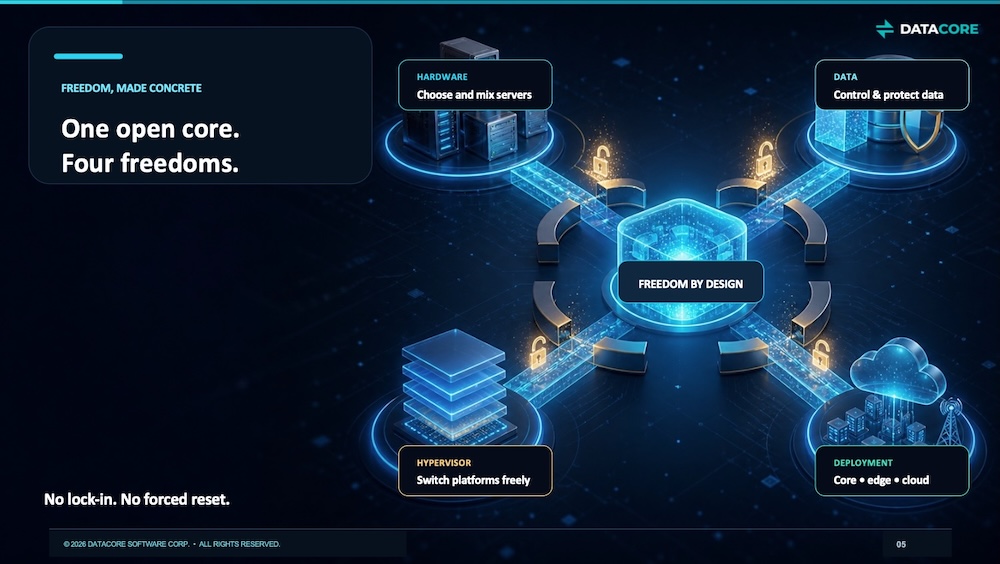
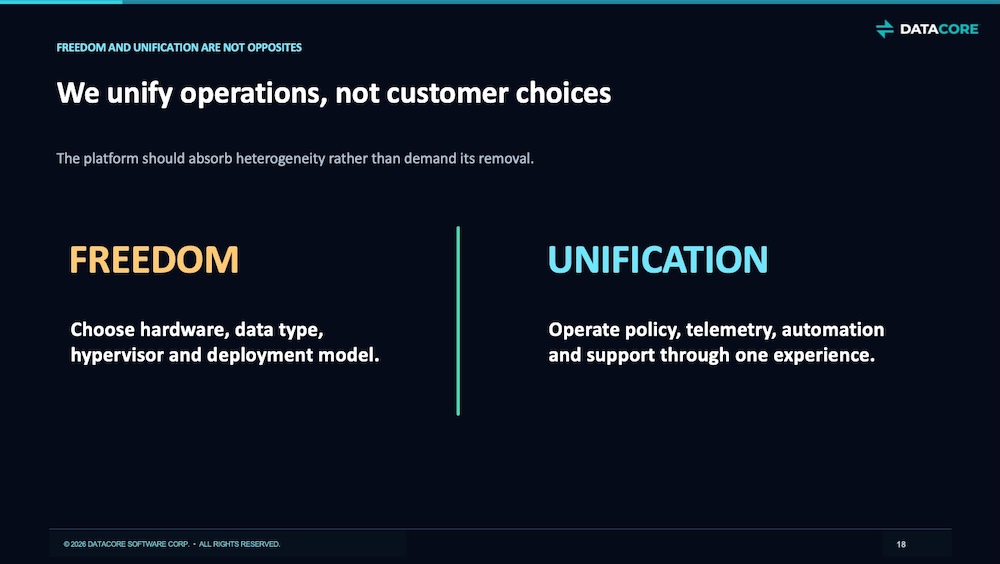
DataCore’s original mission remains unchanged: give customers and partners freedom from infrastructure constraints, platform barriers and data lock-in, allowing them to build and evolve their technology stacks on their own terms. The company translates this philosophy into “four freedoms,” all built around one open core: hardware, with the ability to choose and mix servers; data, maintaining control and protection; hypervisor, with the flexibility to change virtualization platforms; and deployment, spanning core, edge and cloud environments.
This approach has particular relevance in a market where server availability and infrastructure costs remain under pressure. DataCore allows organizations to choose, mix, reuse and refurbish standard x86 hardware from different vendors, reducing hardware dependency. The uncertainty created by Broadcom’s acquisition of VMware also reinforces this positioning. Customers can move between hypervisors such as ESXi, Hyper-V, Proxmox, XCP-ng and Xen while maintaining independent data services and operational continuity.
At the same time, enterprise data is no longer centralized. It is increasingly distributed across core infrastructure, edge locations, cloud-native environments and AI workloads, each requiring different levels of performance, economics and resilience. DataCore refers to this reality as “plurality,” where freedom becomes more valuable but also more complex to manage.
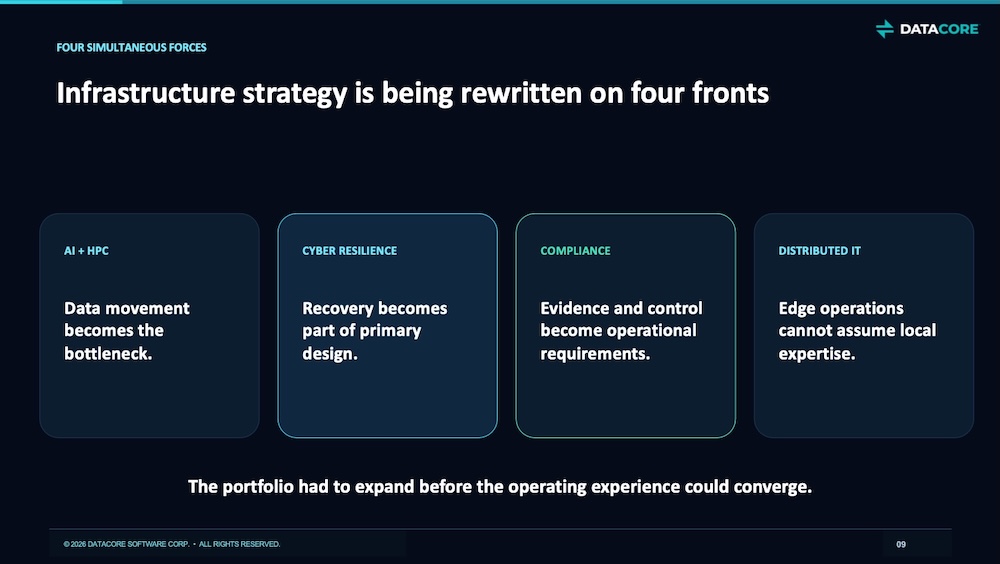
Four major forces are simultaneously reshaping infrastructure strategies. AI and HPC are exposing data-movement bottlenecks; cyber resilience is making recovery a fundamental architectural requirement; regulations such as NIS2, DORA and the Cyber Resilience Act increasingly require evidence of recoverability, tested recovery points and audit trails rather than simply architecture diagrams; and distributed IT continues to expand into edge environments where local technical expertise is often limited.
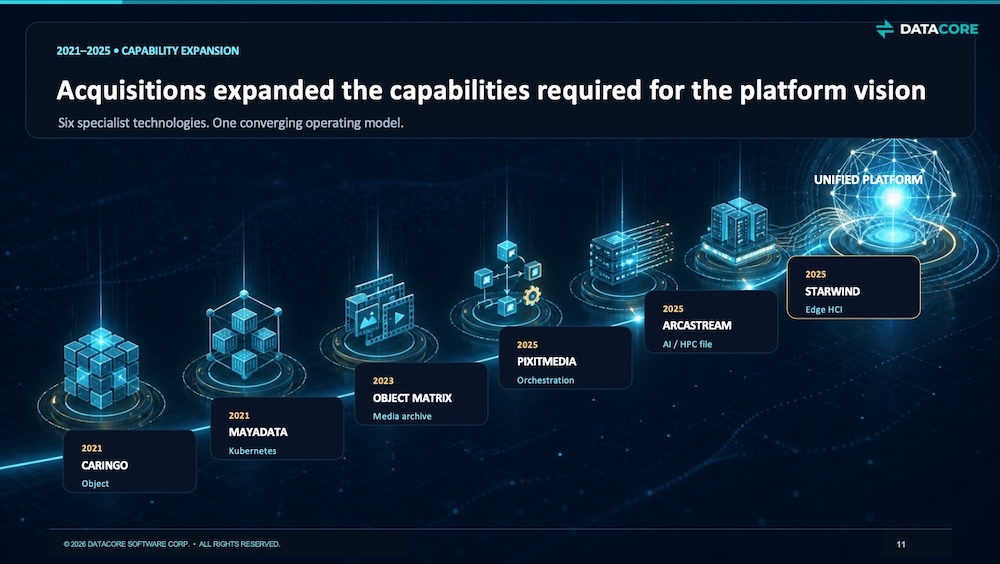
DataCore has significantly broadened its capabilities through acquisitions. The company highlighted six during the presentation: Caringo for object storage in 2021, MayaData for Kubernetes storage in 2021, Object Matrix for media archive in 2023, Pixitmedia for orchestration in 2025, Arcastream for AI/HPC file environments in 2025, and StarWind for edge HCI in 2025.
The key message, however, is that “breadth ≠ unity.” Acquiring specialized technologies represents only the first phase. The real challenge is to unify engineering direction, go-to-market execution, APIs, identity, telemetry and operational functions such as support and lifecycle management.
A few questions remain around this acquisition narrative. We don't know why WIN, acquired in 2023, was not included in the list, and we remain surprised by the way Pixitmedia and Arcastream are sometimes presented. More importantly, DataCore continues to position Arcastream as a parallel file system alongside products such as Swarm and SANsymphony, which provide native object and block storage respectively. Arcastream relies on IBM GPFS, later Spectrum Scale and now Storage Scale, as its underlying parallel file system, adding management and orchestration capabilities on top.
The file storage question is not new for DataCore. As we wrote several years ago, the company clearly needed a file storage offering to complement its portfolio. This explains the 2019 OEM agreement with Hammerspace, when its technology was offered by DataCore under the vFilO name for a limited period.
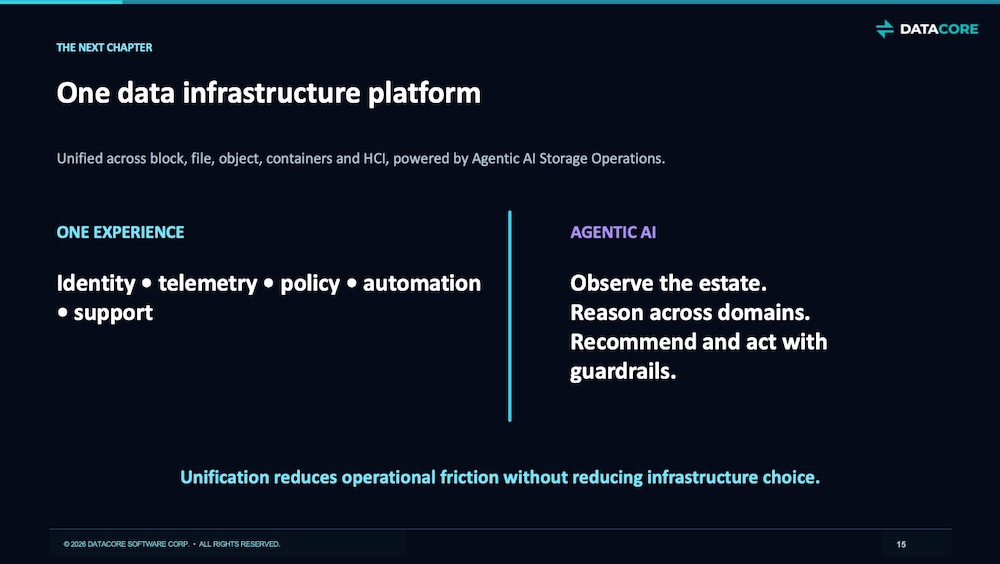
The broader strategy has now clearly evolved from acquisition to integration and ultimately toward a single platform. DataCore summarizes this transformation as Acquire → Integrate → Unify → Autonomize. The ambition is to converge block, file, object, container and HCI storage under one platform experience, sharing identity, telemetry, policy, automation and support while preserving infrastructure choice underneath.
Portfolio unification therefore represents a fundamental component of DataCore’s strategy, but the next step goes further with the introduction of agentic AI into IT and storage operations.
DataCore wants to move beyond dashboards that simply describe problems toward systems capable of helping administrators resolve them. The proposed operational loop follows an Observe → Reason → Recommend → Act model, with human-defined policies and approvals remaining the ultimate control plane. Guardrails include policies, approvals, auditability, rollback mechanisms and explainability.
Initial use cases include capacity prediction, performance bottleneck detection, cyber-resilience verification, compliance monitoring, lifecycle management and support diagnostics. The objective is progressively to automate routine operational decisions while maintaining human oversight for critical actions.
As Said Boukhizou clearly explained during the session, DataCore now has several technology engines moving toward the same destination: SANsymphony for block storage; StarWind for edge, ROBO and SMB HCI; Swarm for cyber-resilient S3 and archive storage; Nexus for parallel file and orchestration; and Puls8 for Kubernetes storage.
The strategic direction is now much clearer: DataCore has spent several years assembling the pieces through acquisitions and is entering the more difficult phase of turning them into a coherent platform. The transition from a collection of specialized storage technologies to a unified operating experience, eventually enhanced by agentic AI, will therefore be one of the key elements to watch.
We expect additional product details around IBC 2026 and later during DataCore Days. These announcements should provide a better indication of how far the company has progressed on product unification, AI-driven operations and its broader corporate trajectory, topics that remain particularly important for DataCore, its executives, employees, investors and industry observers.





0 commentaires:
Post a Comment