


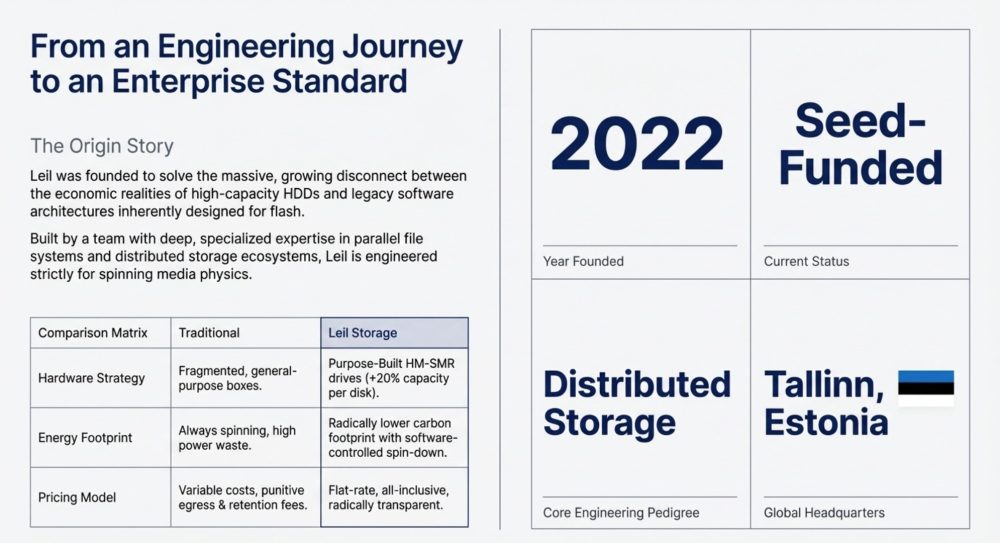
Leil is an Estonian startup founded in 2022 and headquartered in Tallinn, built by engineers with deep expertise in parallel file systems and distributed storage. Currently seed-funded, the company's core mission is to bridge the growing gap between the economic potential of high-capacity hard disk drives and the legacy software architectures originally designed for flash and SSD storage. In short, Leil builds software that makes HDDs perform the way they were physically designed to, something no mainstream storage platform currently does.
The company frames its market opportunity around what it calls the "SMR Paradox." Shingled Magnetic Recording drives offer significantly more capacity per disk, and hyperscalers like Google, Meta, and AWS have already adopted SMR at 100% across their infrastructure using custom-built software. However, the remaining 90% of the enterprise market has achieved zero SMR adoption, simply because no accessible, enterprise-grade software exists to manage these drives properly. Legacy architectures treat modern high-capacity HDDs like slow SSDs, generating small random I/O patterns that waste 30 to 60% of potential capacity economics, require months of tuning per petabyte added, and demand PhD-level specialist staff to operate.
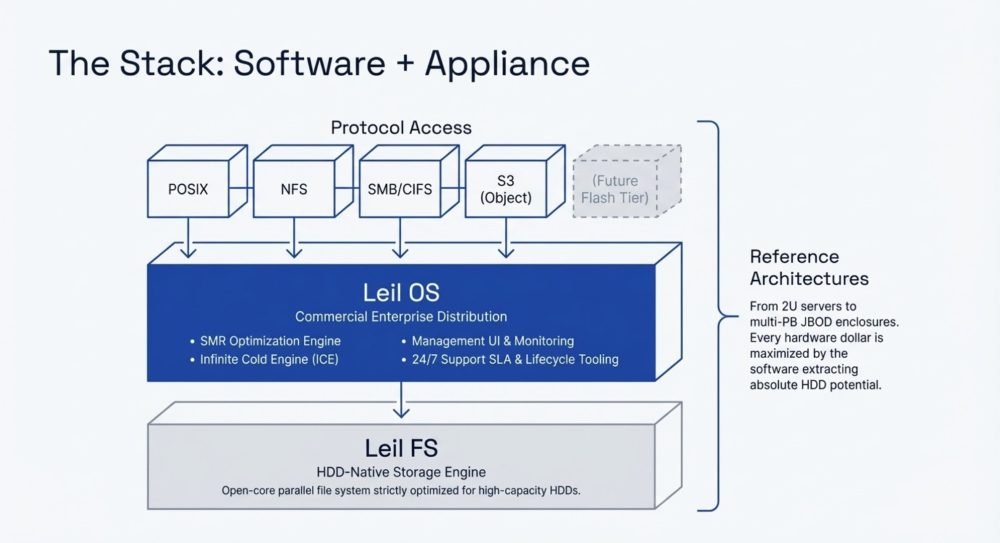
Leil's answer is a two-layer product stack. Leil FS is an open-source parallel file system strictly optimized for high-capacity HDDs, serving as the community adoption engine and baseline for innovation. Leil OS is the commercial enterprise distribution built on top, offering hyperscale-grade efficiency, a management UI, seamless deployment, and 24/7 SLA support. Both are underpinned by the proprietary SMRT Engine, the company's core intellectual property. Key capabilities include a 25% usable capacity gain over generic software-defined storage on identical hardware, tape-level cost per TB from €0.99/TB/month without the retrieval penalty associated with tape, and deployment in 10 minutes via standard repository commands versus 6 to 12 months for traditional SMR integration projects. On performance, Leil OS serializes writes into sequential streams, claiming to unlock 99.7% of theoretical maximum HDD throughput, while its implementation of SNIA Command Duration Limits prevents tail latency spikes critical for AI training workloads. For resilience, a Head Depopulation technology allows Leil to retire only the failing platter surface of a drive rather than triggering a full rebuild, achieving zero-downtime recovery.
Target use cases span AI and HPC warm-tier storage, active archives, enterprise backup qualified with Veeam and Acronis, media post-production for 4K and 8K workflows, on-premises Kubernetes, and CCTV storage. Real deployments include a national broadcaster using Leil OS for multi-petabyte video-on-demand storage, supercomputing centers running national archive projects, and autonomous driving research programs staging telemetry datasets for ML pipelines. The company goes to market through a 100% channel model with white-label and OEM options, and technology alliance partnerships with WD, Seagate, Nvidia, Intel, and AMD. Because Leil OS is built atop the open-source Leil FS under GPL-3.0, customers always retain a guaranteed exit path with no vendor lock-in.





0 commentaires:
Post a Comment