


StorPool is a Bulgarian software-defined storage company founded in 2011, entirely self-funded, profitable, and growing, with roughly 60 employees across Bulgaria and the USA. Serving over one million end users globally across 30 countries on five continents, the company positions itself as the leader in modern block-based software-defined storage, with a mission to create a better world through better data storage and management.
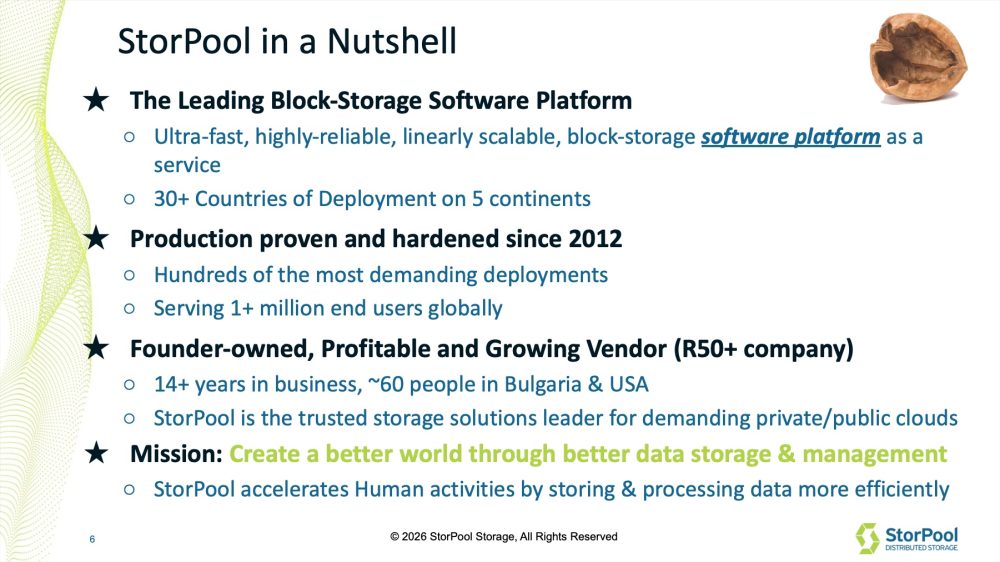
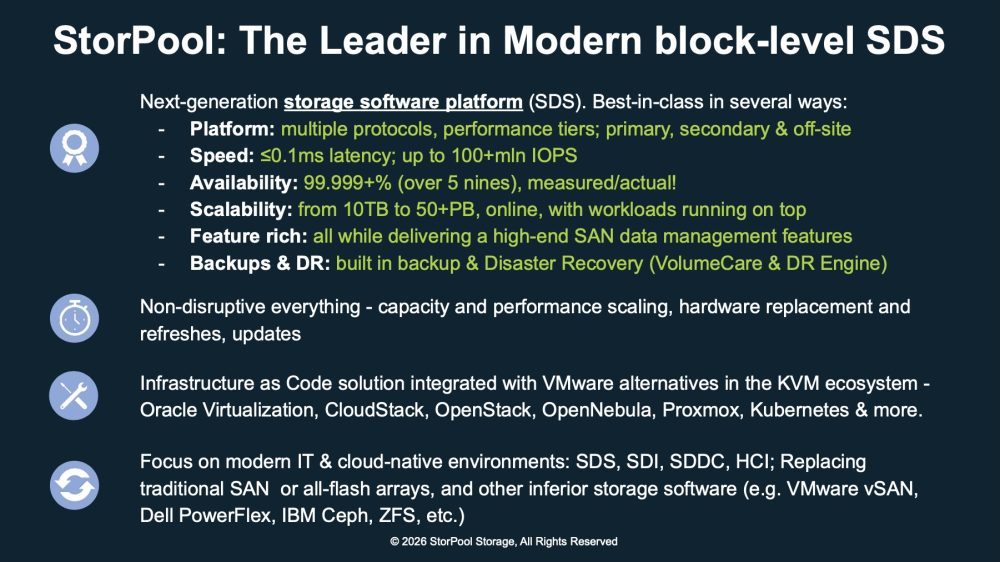
At its technical core, StorPool delivers an ultra-fast, highly reliable, and linearly scalable block storage platform with latency below 0.1ms, up to 100 million IOPS, five-nines availability, and scalability ranging from 10TB to 50+ petabytes with no workload interruption. The platform includes built-in backup and disaster recovery tools and integrates natively with major KVM-ecosystem platforms including OpenStack, CloudStack, Proxmox, OpenNebula, and Kubernetes.
The company organizes its go-to-market around four major industry trends. The first is the VMware exodus triggered by Broadcom's acquisition, which StorPool addresses with a drop-in vSAN replacement, StorPool One, a fully managed KVM platform replacing the entire VMware Cloud Foundation stack at 64% lower five-year TCO, and an Oracle Virtualization bundle delivering 71% savings versus VMware over five years. The second is European data sovereignty, where StorPool responds as a fully European, non-US-owned company participating in the EuroStack initiative. The third is AI infrastructure, where the platform powers GPU-as-a-Service and inference workloads for customers including Redmond.ai and Cloudalize. The fourth is hardware cost pressure, where StorPool's HCI mode consumes only 10–15% CPU and RAM overhead, consolidates over 20 physical components down to 7, and can run approximately 3,000 virtual machines on just 10 servers.
Customer outcomes speak to the platform's broader economic impact: a 15% margin increase for CloudSigma, 60% higher per-rack VM density for Namecheap, a reduction from 50 to just 5 storage staff at Dustin, and elimination of downtime at Atos. End-user workloads running on StorPool-powered infrastructure include those of NASA, ESA, CERN, Siemens, and Deutsche Börse Group. StorPool frames this not merely as storage optimization but as a ripple effect improving the economics of the entire data center, accelerating the broader shift from siloed, manually operated IT toward API-driven, automated, always-on infrastructure.





0 commentaires:
Post a Comment